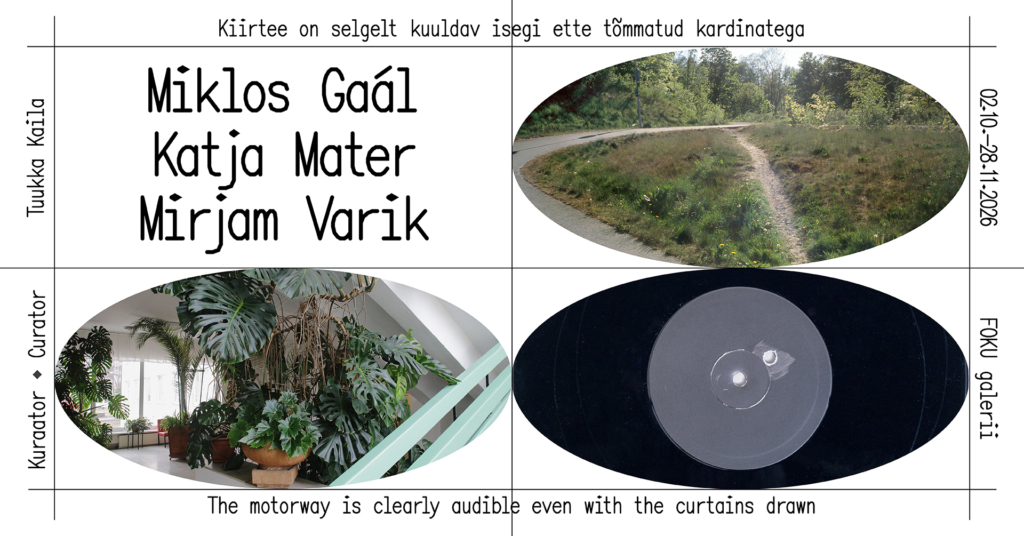
Opening of the international exhibition curated by Tuukka Kaila at the FOKU Gallery on Thursday, 1 October at 6:00 PM
On Thursday, 1 October at 6:00 PM, the international exhibition The motorway is clearly audible even with the curtains drawn will open at the FOKU Gallery. The participating artists are: Miklos Gaál (FI/NL), Katja Mater (BE/NL) and Mirjam Varik (EE). The exhibition is curated by Tuukka Kaila (FI/EE).
The exhibition brings together recent works from three contemporary artists, Miklos Gaál, Katja Mater and Mirjam Varik. Working across a variety of media, a recurring interest in the idea of space can be identified as common ground in their practices, whether through observation, production or conceptualisation.
Historically, space has been closely associated with scientific representation, whereas time has been the object of philosophical study. More recent theorisation of both dismantles this separation. Space as an evolving social construct [1], a negotiation between physical properties and their subjective interpretation reflecting back on the interpreters, emerges in the writings of Henri Lefebvre and Doreen Massey from the 1970’s onwards. The authors understand space as actively produced [2], whether intentionally or unconsciously, through individual and collective behaviour. Gradually, the focus of spatial theory has been shifting towards the lived experience and habits of people and communities. Space has become an actor in the network of social interaction and political reality, crucial for people’s understanding of themselves and their interrelations. This new creative space of open possibility and endless potential trajectories enables the “creation of unpredictable novelty where the possible is richer than the real.”[3]
Miklos Gaál‘s slide showCommon Sense results from an ongoing, habitual observation of shortcuts in public spaces. What begins as intuitive choices, made independently and in the moment by individuals, evolves over time into behavioural patterns recognisable as collective spatial practice, as the same choices are made again and again by more and more people. The shortcut is made together, it is for everyone. Common Sense seems to celebrate the shortcut as a very basic form of voluntary participation in the creation of shared space.
Mirjam Varik‘s work Silence in the Fading Room explores the cohabitation of people and plants in semi-public spaces. It is also a dive into the stairwells of Soviet-era apartment buildings, office lobbies and various thoroughfares fairs: spaces where people linger momentarily on their way from one place or state of being to another, but where the pictured plants often spend their entire lives. In Varik’s photographs, the presence of plants in these spaces makes visible the way in which individual people seek to form a relationship with their immediate surroundings by cultivating and befriending the plants.
Presented at the FOKU Gallery as an installation, Katja Mater‘s work Two Intersecting Loops of Silence is a study of time, sound and perception, combining conceptual philosophy with material experimentation and using sound as a representation of its own absence. The experimental double-sided 10-inch record turns time into matter and silence from the absence of sound into an active spatial experience.
Side A of the record features two locked silent grooves, each centred around one of two centre holes: one central, one off-centre. When played from either position, the grooves intersect and produce a merely mechanical ticking sound, echoing the passing of time. In the course of the exhibition the grooves wear and scratch, changing the soundscape of the gallery. Side B reimagines the record as an image carrier. To produce audio records, a master plate is used for pressing vinyl copies. Instead of audio, Mater has etched a drawing directly into the copper layer of the master plate. When played, the record’s rotation produces no sound but instead animates the drawing.
The title of the show The motorway is clearly audible even with the curtains drawn quotes an Airbnb user review opening up a private space for public scrutiny. On the platform, users share their experiences of the listed spaces with the purpose of helping others imagine what it’s like to spend time in them.
The exhibition will remain open until 28 November 2026.
[1] Doreen Massey, For Space (London: SAGE Publications Ltd, 2005).
[2] Henri Lefebvre, The Production of Space (Oxford: Blackwell Publishers, 1991; algselt ilmunud prantsuse keeles pealkirja all La production de l’espace Paris: Anthropos Press, 1974).
[3] Ilya Prigogine, The End of Certainty: Time, Chaos and the Laws of Nature (London: Free Press, 1997), lk 72.
Artists
Miklos Gaál (FI/NL, b. 1974) is a visual artist and a doctoral researcher in fine arts. Gaál is interested in the subjective nature of experience. His artistic practice merges changing formats of photography, film, text and printed matter as an ever-evolving inquiry about subverting habitual distinctions about actuality. His current PhD project compares romantic irony, the historical 1790s progressive idea about compassionate ambivalence known as the literary criticism of Jena romanticism, with visual arts. Gaál lives and works in Amsterdam and Helsinki.
Katja Mater‘s (BE/NL, b. 1979) work investigates how images shape—and distort—our sense of reality. Dyslexia informs the artist’s ways of working: the visual approach to language, perception of words as shapes and time as layered rather than sequential. This temporal logic runs through Mater’s practice, where photography, film, drawing, performance, sound objects and installation intertwine to invite the audience into an embodied experience where meaning emerges through looking. Mater lives and works between Amsterdam and Brussels.
In her artistic practice, Mirjam Varik (EE, b. 1990) articulates seemingly insignificant moments that nonetheless have a lasting impact on human development. Through photography, video and installation, she explores childhood experiences and identity in a narrative manner, focusing on memories, places and phenomena. Varik lives and works in Tallinn.
Curator
Tuukka Kaila (FI/EE, b. 1975) is an artist, publisher and educator who divides his time between a studio and publishing practice in Helsinki and a professorship of photography at the Estonian Academy of Art in Tallinn. He works across photography, sound and text with a curiosity towards abstraction, duration, contextual shifts and epistemic diversity. Kaila is the co-founder of the publishing initiative Rooftop Press, (2016–). He lives and works in Helsinki and Tallinn.
FOKU Gallery is a gallery-showroom focused on contemporary lens-based art. FOKU Gallery is run by the Estonian Union of Photography Artists (FOKU).
Support:
Cultural Endowment of Estonia
Alfred Kordelin foundation
Partner:
Rüki Gallery
Opening drinks by:
Mikkeller
Team:
Printing and framing: Andres Toodo
Wood work: Villem Säre
Image processing: Marje Eelma
Video files preparation and sound consultation: Madis Kurss
Editing and Estonian translation: Mari Volens
Text consultation: Miklos Gaál
Thanks:
Miklos Gaál, Hedi Jaansoo, Madis Kurss, Kulla Laas, Katja Mater, Mirjam Varik, Mari Viita-aho, Mari Volens and EKA Department of Photography
FOKU Gallery
Väike-Karja 10, Tallinn
Thu–Sat 12–18
Free entrance